Why Local SEO Is Important for Small Businesses (And How It Drives Real Growth)
If you run a small business, visibility isn’t optional — it’s survival.
But here’s the truth many business owners don’t realize:
You don’t need to be visible everywhere. You need to be visible in the right places, especially locally.
That’s where local SEO for small businesses becomes one of the most powerful growth tools available.
Whether you’re a service provider, consultant, retail shop, contractor, nonprofit, or manufacturer, your potential customers are already searching for businesses like yours. The question isn’t if they’re searching.
It’s whether they can find you instead of your competitors.
Local SEO helps make that happen.
(Updated August 2026)
Why is local SEO important for small businesses?
Local SEO helps small businesses appear in search results when people in their area are looking for services, products, or solutions nearby. By optimizing your website, Google Business Profile, and online listings, local SEO makes it easier for potential customers to discover, contact, and visit your business.
What Is Local SEO?
Local SEO (Search Engine Optimization) is the process of optimizing your online presence so your business appears in local search results when people look for services, products, or solutions near them.
Examples include searches like:
“marketing consultant near me”
“best coffee shop in Pittsburgh”
“nonprofit grant writer Pennsylvania”
“small business consultant Carnegie, PA”
When your local SEO is strong, your business appears in:
Google map results
Local search listings
Google Business Profile results
Organic website search results
Voice search results
This dramatically increases your chances of being discovered by people who are ready to take action.
Most people looking for a local business start on Google — and they're usually looking for someone nearby who can help now, not someone three states away.
Why Local SEO Is Important for Small Businesses
1. Local SEO for Small Businesses Brings You High-Intent Customers
Unlike social media scrolling, local search happens when someone is actively looking for a solution.
That means local SEO connects you with people who are:
ready to hire
ready to visit
ready to call
ready to buy
These are not passive viewers; they are decision-makers.
For small businesses with limited marketing time and budget, this makes local SEO one of the highest-ROI strategies available.
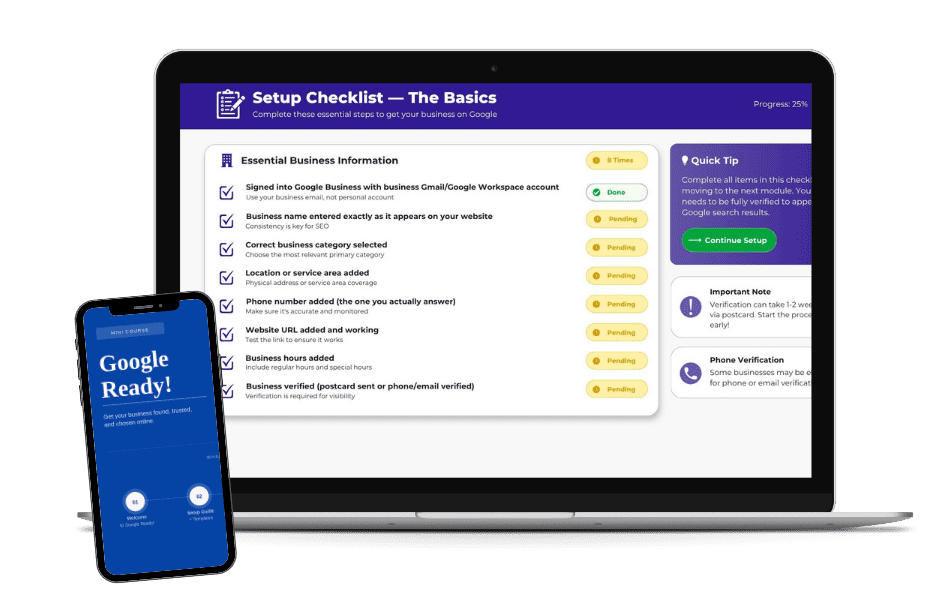
Ready to set up your Google Business Profile the right way?
Get Google Ready walks you through the exact process our retainer clients use — step by step, in under 2 hours. No ads. No agency. No tech headaches.
👉 Get Instant Access for Just $27 →
2. It Builds Trust Before You Ever Speak to a Prospect
When someone searches for your business and finds:
a professional website
consistent contact information
positive reviews
updated photos
You instantly gain credibility.
Local SEO for small businesses isn’t just about visibility, it’s about confidence.
People trust businesses that look established, easy to contact, and active online.
3. It Helps You Compete Without Massive Marketing Budgets
Small businesses often feel like they’re competing against companies with larger teams, bigger ad budgets, and more resources.
Local SEO levels the playing field.
You don’t need to outspend competitors, you need to out-optimize them.
A well-optimized Google Business Profile, strong local content, and consistent listings can outperform businesses spending heavily on ads but ignoring local search optimization.
In fact, affordable SEO for small businesses — done correctly — is one of the highest-return investments you can make without a big marketing budget.

4. Local SEO Drives Phone Calls, Website Visits, and Walk-Ins
Local SEO creates action.
It leads to:
phone calls directly from search
website visits from local prospects
appointment bookings
direction requests
in-store visits
These are measurable behaviors tied directly to revenue.
And unlike social media visibility, local SEO often continues working long after the initial optimization effort.
5. It Supports Referral and Word-of-Mouth Growth
Even when someone hears about your business through a referral, what’s the first thing they do?
They Google you.
If your business is easy to find and looks professional online, referrals convert faster and with less friction.
Local SEO for small businesses strengthens every other marketing channel you use.
For example, a small consulting firm that optimizes its Google Business Profile, collects client reviews, and publishes locally relevant content can often outrank larger firms that ignore local search optimization.
How to Do Local SEO for Your Small Business: 7 Steps
You don't need an agency or a technical background to do this. Here's the order I walk clients through, and roughly what each step costs you in time.
Step 1: Claim and fully complete your Google Business Profile (60 minutes)
This is the single highest-return hour in local SEO. Go to google.com/business, claim your listing, and verify it — Google will mail a postcard or verify by phone or video. Then fill in every field. Not most of them. Every one. Incomplete profiles get shown less often, and the fields most owners skip — service areas, hours, attributes, products, and the description — are exactly the ones Google uses to decide whether you match a search.
Step 2: Get your primary category right (10 minutes, and it matters more than you'd think)
Your primary category has more influence on local rankings than almost anything else on your profile, and most owners pick something vague like "Consultant" or "Business Service." Be specific: "Marketing Consultant" beats "Consultant." "Sheet Metal Contractor" beats "Contractor." Search the term your customers would use, see what categories your top-ranking competitors chose, and match the specificity. You can add secondary categories after — but only ones you genuinely serve.
Step 3: Make your name, address, and phone number identical everywhere (2 hours)
Google cross-references your business details across the web to confirm you're real. Inconsistency creates doubt. Pick one exact format — including whether you use "St." or "Street," "Suite 200" or "#200" — and make it match on your website, Google Business Profile, Facebook, LinkedIn, Yelp, your industry directories, and your chamber of commerce listing. Fix the mismatches you find. This is tedious and it works.
Step 4: Put your location where Google can actually read it (1 hour)
Your city and service area need to appear in your page titles, your headings, and your body copy — not just in the footer. If you serve multiple areas, give each significant one its own page with genuinely different content, not the same page with the city swapped out. Add your address and phone in the footer of every page, and make the phone number a clickable link on mobile.
Step 5: Get your first 10 reviews (2 weeks of asking)
Reviews affect both your ranking and whether anyone calls you. Ten recent, specific reviews beat forty vague ones from four years ago. Ask in person or by email right after you've delivered something good, send the direct review link so it's one click, and reply to every review you get — Google reads your replies too. Never offer anything in exchange for a review; it violates Google's policies and can get your reviews removed.
Step 6: Post to your Google Business Profile twice a month (15 minutes each)
Most small businesses set up a profile and never touch it again. Posting keeps it active, gives you more surface area in search results, and lets you show what you actually do. A finished project, a seasonal update, a common customer question answered, a photo from a job site. Nothing elaborate — consistency is the whole point.
Step 7: Publish one genuinely local piece of content a month (2 hours each)
This is what separates businesses that rank from businesses that just exist online. Write about things only a local business could write: a project you completed in a specific area, a regulation that affects your industry in your state, an answer to a question your local customers keep asking. Generic content gets buried. Specific local content is how a small business outranks a national one.
Where most people stop: steps 1 through 3 take an afternoon and produce most of the results. If you only do three things, do those.
The Long-Term Advantage of Local SEO
Local SEO is not a one-time tactic — it’s a long-term visibility asset.
Unlike paid ads that stop when spending stops, strong local optimization continues generating traffic, leads, and credibility over time.
For small businesses looking for sustainable growth without constant content creation pressure, local SEO provides stability and predictability.
FAQs
What's the first thing a small business should do for local SEO?
Claim and fully complete your Google Business Profile. It's free, it takes about an hour, and it's the listing Google uses to decide whether to show your business in map results and local searches. Businesses with complete profiles get significantly more visibility than those with partial ones — and most small businesses have partial ones.
How do I do local SEO myself without hiring an agency?
You can do the core of local SEO yourself in about a day of focused work: claim and complete your Google Business Profile, choose a specific primary category, make your business name, address, and phone number identical everywhere online, and ask your recent customers for reviews. Those four steps produce most of the results. Hiring help makes sense later, when you want ongoing local content and competitive analysis.
How long does local SEO take to work?
Most businesses begin seeing improvements within 3–6 months depending on competition and how optimized their online presence is.
Is local SEO different from regular SEO?
Yes. Local SEO focuses on geographic visibility, helping businesses appear in searches within a specific city, region, or service area.
Do small businesses really need local SEO?
Yes. Even businesses that rely on referrals benefit because most prospects search online before contacting a company.
What's an affordable SEO plan for a small business just getting started?
Start with the basics — set up and optimize your Google Business Profile, make sure your website clearly states what you do and where you serve, and focus on getting your first few client reviews. These three local SEO tips alone can dramatically improve your visibility without spending a dollar on ads. Once those are in place, consistent local content like blog posts is your next best move.
Want to skip the guesswork and just get it done?
Get Google Ready — the step-by-step guide to getting your business found on Google in under 2 hours.
Just $27.
Final Thoughts
Small business growth doesn’t come from being everywhere.
It comes from being visible where it matters most.
Local SEO helps your business show up when people are actively looking for what you offer, builds trust before conversations begin, and creates a steady flow of discovery that compounds over time.
If you want more calls, better leads, and stronger local credibility, improving your local SEO is one of the smartest investments you can make.